
Circularity Bridging Academia, Industry and Policy
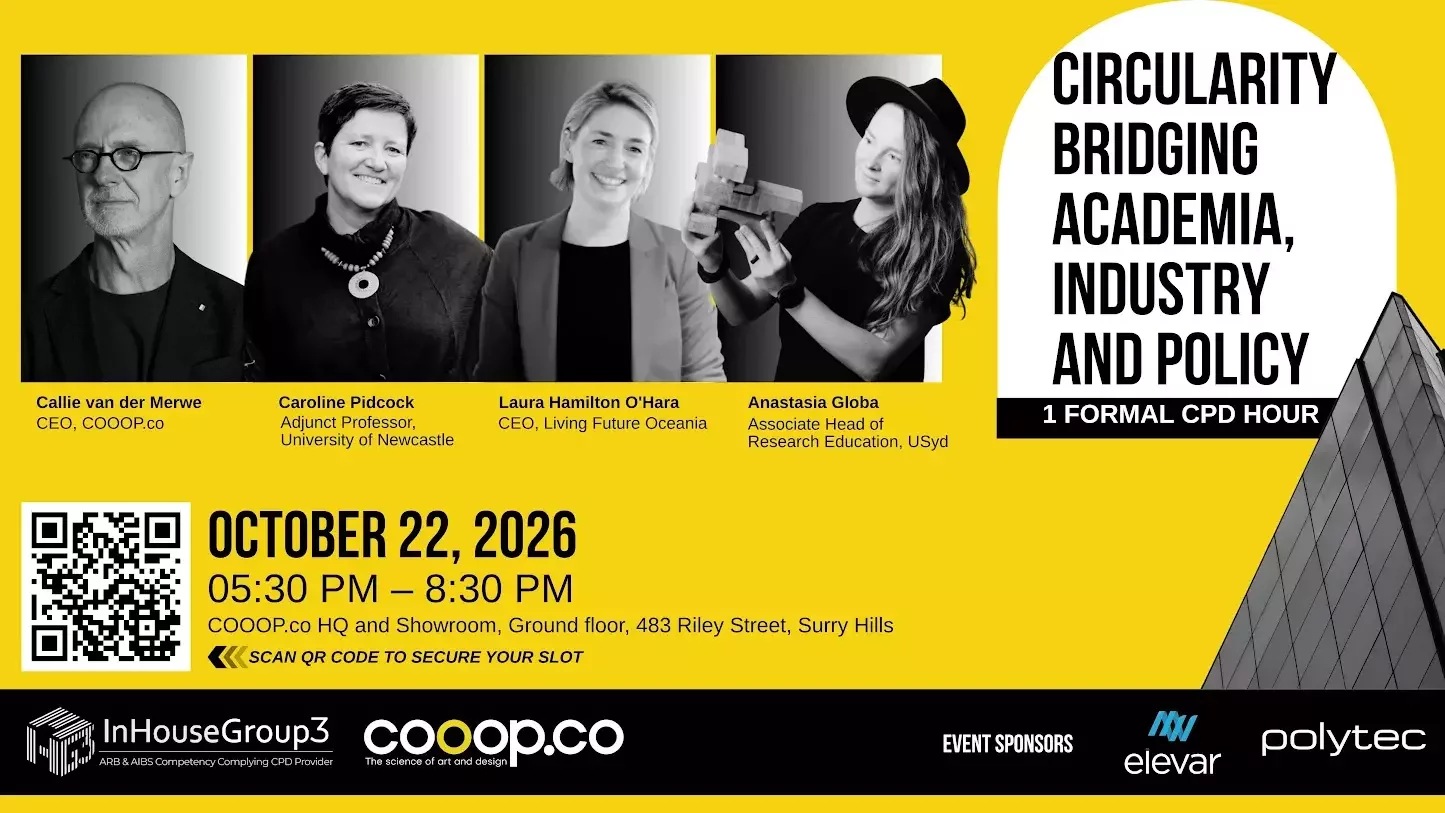
Join us for an engaging evening bringing together academia, industry and policy to explore the evolving role of circularity in the built environment.
Designing Sustainable Futures: Research, Technology & Impact
Anastasia Globa
This presentation explores how emerging technologies such as artificial intelligence, extended reality (XR), simulation, and sustainability visualisation tools are transforming the way we design, evaluate, and communicate outcomes in the built environment. Through examples from research and practice, attendees will learn how digital innovation can support environmental, social, and economic sustainability while helping bridge the gap between research and real-world implementation.
Biography
Dr Anastasia Globa is an Associate Head of Research Education at the University of Sydney. Her research explores how emerging technologies, including AI, XR, multi-sensory simulation, and digital design tools, can support more sustainable, inclusive, and evidence-based decision-making in the built environment. She works at the intersection of research, industry, and innovation, translating new knowledge into practical tools and real-world impact.
At the end of the presentation, attendees will be able to understand:
- By the end of this session, attendees will be able to identify how emerging digital technologies can be used to support more sustainable and evidence-based design decision-making.
Transparency as First Step to Circularity
Laura Hamilton O'Hara
Transparent materials make risk (such as chemicals of concern) and opportunities (what can actually be used again/circular) visible to anyone3rd party certifications like Declare creates integrity through accountabilityThe benefits and need for tools, certifications and organisations to work together in creating a common language for circularity that can be understood and relied upon years after a product has been specified.
Biography
Laura has a Master’s Degree in Social Ecology and two decades of industry experience working in conservation, sustainability and social justice in Australia and South Africa. A through line for Laura in all her work is sustainability leadership and leverage points in systems. She was recognised for this as one of the 50 Women in Global Sustainability Leadership by Sustainability X Magazine in 2022. After several years in roles at Taronga Zoo, Macquarie University and the Centre for Sustainability Leadership, Laura is currently the CEO of Living Future Oceania (LFO). LFO harnesses the built environment as a powerful vehicle to create a world that is socially just, culturally rich, and ecologically restorative.
Who Pays for Circularity? Designing Spaces That Serve People and Planet
Callie van der Merwe
Design teams are skilled at satisfying codes and reducing waste, yet the effect of a space on human behaviour is far harder to measure. This session looks at what happens when a circular solution delivers a worse outcome for the people using the space, and who carries the cost of getting the balance right. Callie explores how reduced replacement and waste can sit alongside flexible spaces that support healthy behaviour. For practitioners and clients, this matters because a circular decision that works for the planet and fails its occupants is unlikely to last.
Biography
Callie van der Merwe is an award-winning architect and founder of COOOP.co, whose three-decade career spans thousands of hospitality and commercial fit-outs across Africa, Europe, the Middle East and Oceania. Having overseen design decisions across more than 10,000 venues, he argues that circularity choices sit squarely with the designer. He created Envirohacking®, linking environmental psychology to behaviour, and developed Design for ROI, treating sustainable design as a business performance tool.
At the end of the presentation, attendees will be able to understand:
- Participants will be able to evaluate a circular design decision against environmental, human behavioural and commercial criteria, and identify where a waste reduction strategy may compromise the wellbeing of the people using the space.
Shifting Mindsets - moving to regeneration
Caroline Pidcock
According to systems expert Donella Meadows, our mindsets are the most impactful way of changing systems. How do we have different conversations that inspire better, more regenerative ways of working? Caroline will talk about how Handprints of Good Design can shift the systems we are in and move from doing less bad, to doing actual good with every project.
Biography
Caroline Pidcock is an architect, adjunct professor of practice, board director and changemaker working at the intersection of design, climate action and regenerative practice. With over 30 years of leadership experience in architecture and across professional, not-for-profit, government and advocacy boards, she brings deep expertise in sustainability, governance, and community engagement to ideas that restore and regenerate people, place, and planet.
Sponsors